Get your fix of everything retro — specialists in imported & rare retroImported & Rare Retro

Shop By
Lylat Wars vs. Star Fox 64: The Story Behind the N64 Classic’s Two Names
Ever stared at two Nintendo 64 cartridges, one labelled 'Star Fox 64' and the other 'Lylat Wars', and wondered if you were seeing double? It's a...

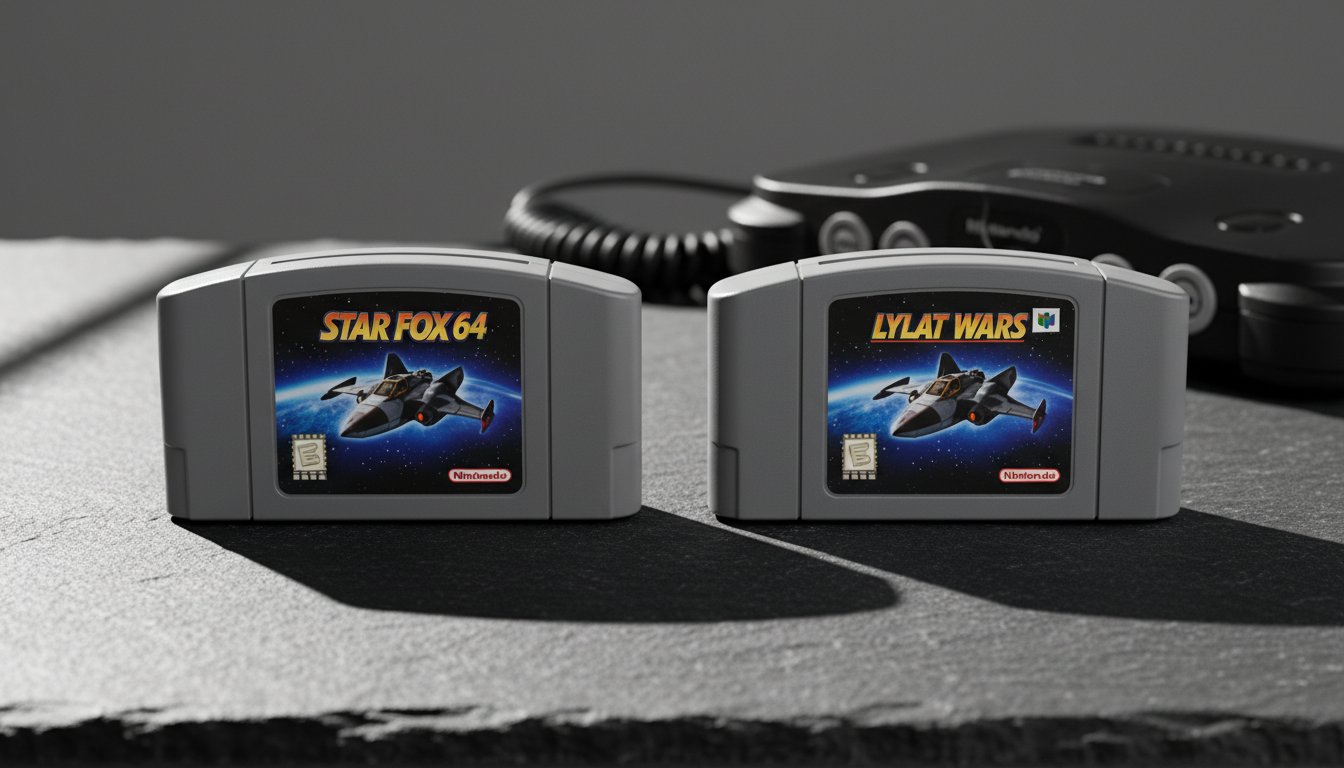
Ever stared at two Nintendo 64 cartridges, one labelled ‘Star Fox 64’ and the other ‘Lylat Wars’, and wondered if you were seeing double? It’s a classic conundrum for any retro gaming fan here in the UK, a question that has sparked countless playground debates. The mystery surrounding Lylat Wars vs. Star Fox 64 is a legendary piece of N64 history, but the truth behind this iconic rail shooter’s identity crisis is more than just a simple name swap. For collectors, knowing the difference is essential to getting the right fix for their collection.
So, are they actually the same game? Does the PAL version have any differences beyond the name on the box? Fear not, pilot! In this article, we’re jumping into the cockpit to give you the definitive answers. We’ll uncover the surprising legal reason for the name change and break down exactly what it means for UK collectors today. By the end, you’ll know precisely which version to hunt down for your cherished N64, ensuring you add the correct classic to your shelf with total confidence. Let’s do a barrel roll and get started!
The Burning Question: Why is Star Fox 64 Called Lylat Wars in the UK?
If you grew up gaming in the UK, you probably have cherished memories of barrel-rolling through Corneria in Lylat Wars on your N64. But chat with a friend from the US or Japan, and they’ll call it Star Fox 64. So, what gives? The simple, direct answer is a classic 90s trademark dispute. Nintendo couldn’t use the ‘Star Fox’ name in Europe because of a potential legal conflict with a German technology company named StarVox. To avoid any headaches, Nintendo of Europe opted for a complete rebrand for its PAL release, and an iconic alternate title was born.
The Trademark Clash Explained
Nintendo’s decision was a purely preventative legal move to avoid any brand confusion between their iconic space shooter and the German firm’s hardware. While it seems strange today, changing game titles for different regions was surprisingly common back then. The legendary Star Fox 64 wasn’t the only Nintendo classic to get this treatment; many will remember Kirby Super Star being sold as Kirby’s Fun Pak here in the UK. The difference between lylat wars star fox 64 was therefore a matter of marketing and law, with zero impact on the incredible gameplay itself.
What are PAL and NTSC Regions?
The name change was applied across all “PAL regions,” a term you’ll see constantly in the retro gaming world. These acronyms refer to the old-school television broadcast standards that dictated how games were displayed on-screen. For any budding collector, understanding them is essential.
- PAL (Phase Alternating Line): The standard used in the United Kingdom, most of Europe, and Australia. It ran at a 50Hz refresh rate.
- NTSC (National Television System Committee): The standard used in North America and Japan. It ran at a faster 60Hz refresh rate.
This technical difference is why you can’t just pop an American NTSC game into a standard UK PAL Nintendo 64 and expect it to work. Your console and your games need to match the same regional standard to function correctly-a crucial tip to remember when building your collection!
Are They Actually Different Games? A Head-to-Head Comparison
Let’s get right to the heart of it: are Lylat Wars and Star Fox 64 different games? The big, reassuring answer is no. Underneath the different names and box art lies the exact same iconic N64 masterpiece. Whether you’re firing up a PAL or NTSC cartridge, you are getting the full, unadulterated Arwing experience that defined a generation of 3D shooters.
The story, the characters, the legendary voice acting, and the core gameplay mechanics are absolutely identical. So, if you’re worried you missed out on some secret content or a different campaign, you can relax. The differences that do exist are almost entirely technical, stemming from the way games were prepared for different television standards back in the 90s.
Core Gameplay & Story: A Perfect Match
From the opening scramble on Corneria to the final assault on Venom, the gameplay in lylat wars star fox 64 is a perfect mirror of itself. You’ll still experience the same thrilling mix of on-rails shooter sections and the more open “All-Range Mode” dogfights. The branching mission paths, which gave the game its incredible replay value, are completely unchanged. Rescuing Falco on Corneria or taking down the Star Wolf team on Fortuna offers the same challenge and reward in both versions.
The PAL vs. NTSC Technical Divide
The most significant difference comes down to the classic PAL vs. NTSC debate that affected most 90s console games in Europe. The PAL version (Lylat Wars) was optimised for 50Hz European TVs, while the NTSC version (Star Fox 64) was built for 60Hz displays in North America and Japan. For the player, this results in a couple of noticeable effects:
- Game Speed: The PAL version runs approximately 17% slower than its NTSC counterpart. While the game was optimised to feel responsive, purists and speedrunners will notice the difference in speed and reaction time.
- Letterboxed Display: To fit the 60Hz image onto a 50Hz screen without distortion, many PAL N64 games, including Lylat Wars, feature black bars at the top and bottom of the screen.
For most casual players just looking to relive a classic, these technical quirks are minor and don’t spoil the fun. However, for the best possible experience, playing the 60Hz NTSC version is the definitive choice.
Minor Localisation Tweaks
Beyond the technical aspects, the changes are minimal. The PAL Lylat Wars cartridge includes support for multiple European languages, which you can select on startup. Aside from the obvious title swap-a fascinating story involving a German tech company and the reason for the name change-any in-game text differences are trivial. Critically, the cherished English voice acting, with all its quotable “Do a barrel roll!” glory, is identical across both regions.
More Than a Name: Why Lylat Wars Remains an N64 Legend
While the name on the box differed across regions, the groundbreaking experience inside was universal. The legacy of Lylat Wars Star Fox 64 is built on pure innovation and unforgettable moments that defined a generation of gaming. It wasn’t just another shoot ’em up; it was a cinematic, on-rails masterpiece that pushed the Nintendo 64 to its limits. Regardless of the title on the cartridge-a simple branding decision, and you can read about the real reason for the name change in detail-the game was an absolute classic that felt truly next-gen.
‘Do a Barrel Roll!’: Iconic Characters & Dialogue
Long before memes were even a thing, Lylat Wars was creating them. The constant, cheesy, and brilliant voice-acted chatter from your wingmen gave the Star Fox team a personality that was impossible to ignore. From Peppy Hare’s frantic “Do a barrel roll!” to Falco’s arrogant “Hey, Einstein, I’m on your side!”, these lines are seared into our collective memory. This wasn’t just background noise; it gave every battle a sense of camaraderie and urgency that still holds up today.
Revolutionising Gameplay with the Rumble Pak
Can you even imagine playing Lylat Wars without feeling it? This was the game that introduced the world to the N64 Rumble Pak, and here in the UK, it was bundled right in the box. For the first time on a home console, you could feel the kick of your lasers, the shudder of an enemy explosion, and the jarring impact of taking a hit. It was a monumental leap forward for player immersion, adding a tactile layer to gameplay that quickly became an industry standard.
Branching Paths to Victory
One of the game’s most ingenious features was its non-linear level design. Simply surviving a stage wasn’t enough. By completing specific, often hidden, objectives-like flying through all the stone arches on Corneria or defeating Star Wolf-you would unlock a different, more challenging route through the Lylat system. The end-of-level screen showing “Mission Accomplished” instead of “Mission Complete” was the ultimate reward, promising a new adventure and giving the game immense replay value that kept us all coming back for more.
It’s this perfect blend of cinematic flair, technical innovation, and masterful design that cements the legacy of Lylat Wars Star Fox 64. It’s a cornerstone of the N64 library, and a must-have for any serious collector. Ready to revisit the Lylat system? Get your fix of classic N64 games and relive the magic.
A Collector’s Guide: Buying Lylat Wars in the UK Today
So, you’re ready to dive back into the Lylat system and do a barrel roll! For gamers in the UK, hunting down this iconic N64 classic means you’re looking for Lylat Wars. It’s not just a name change; it’s a matter of compatibility. Your UK Nintendo 64 is a PAL console, and it needs a PAL game to run without any clunky adapters or modifications. Grabbing an American copy of Star Fox 64 just won’t work out of the box. Here’s how to add this cherished piece of gaming history to your collection the right way.
What to Look For in a Used Copy
When you start your search, you’ll see two main options: ‘cartridge only’ or ‘Complete in Box’ (CIB). A loose cart is perfect for just playing the game and will typically cost around £15-£25. A CIB copy, which includes the original box and instruction manual, is the collector’s choice and can fetch £50 or more depending on its condition. Always check photos for the cartridge contacts; they should be clean and free of corrosion. For boxed copies, look for major rips, fading, or water damage on the cardboard and manual, as this heavily impacts its value.
Ensuring Authenticity
The retro market is, unfortunately, home to some convincing fakes. Protecting your investment means knowing what to look for. Here are a few quick checks to spot a counterfeit lylat wars star fox 64 cartridge:
- The Nintendo Logo: On the back of the cartridge, inspect the moulded Nintendo logo. The dot on the ‘i’ should be a perfect square, not a circle. This is a classic giveaway.
- Production Stamp: Look closely at the back label. A genuine cart will have a two-digit number lightly stamped into the sticker. It can be faint, but its presence is a very good sign.
- Trust Your Gut: If a price on an online marketplace seems too good to be true, it probably is. Shady sellers often use stock photos and offer suspiciously low prices for “brand new” copies.
Where to Find Your Copy
Specialist retro gaming stores are your most reliable source. They’re run by fellow enthusiasts who test and verify their stock, giving you peace of mind. Online marketplaces like eBay can be great for finding a deal, but you need to be cautious and vet the seller carefully. For a worry-free experience, it’s always best to buy from a trusted expert who guarantees their products. Why not get your fix with our tested and authentic N64 games! We live and breathe this stuff, so you know you’re getting the real deal.
A Legend by Any Name: The Lylat System Awaits
Whether you knew it as the PAL-region title born from a trademark dispute or its famous North American counterpart, the core truth remains: the game is an absolute masterpiece. Ultimately, the story of lylat wars star fox 64 is one of a single, brilliant game that delivered unforgettable dogfights and cinematic action, regardless of the name on the cartridge. It’s a testament to Nintendo’s golden era, a cherished memory for millions of N64 fans across the UK and a must-have for any serious collector.
Ready to relive those epic barrel rolls and save Corneria all over again? As passionate experts who live and breathe this stuff, we’re specialists in authentic retro and imported games. Every classic we sell is professionally tested and graded because we believe you deserve the best. Get your fix and browse our full collection of Nintendo 64 classics!
Happy collecting, and we’ll see you in the skies.
Frequently Asked Questions
Can you play the American Star Fox 64 on a UK Nintendo 64 console?
Unfortunately, you can’t play an American NTSC copy of Star Fox 64 on a standard UK PAL console straight out of the box. Nintendo 64 consoles are region-locked, meaning they can only play games from their specific territory. The physical cartridges also have different plastic tabs on the bottom, preventing them from fitting into a console from another region. To play it, you would need a special adapter or to physically modify the console’s cartridge slot.
Was the Rumble Pak included with every copy of Lylat Wars?
For its initial launch, yes! The iconic “Big Box” version of Lylat Wars proudly included the brand-new Rumble Pak, making it the must-have bundle to experience true force feedback for the first time. This was a huge selling point and a cherished memory for many gamers. Later on, Nintendo released a standard, smaller-boxed version of the game on its own to offer a lower price point for players who might have already purchased a Rumble Pak separately.
Is Lylat Wars the same as Star Fox 64 3D on the Nintendo 3DS?
While they share the same timeless story and gameplay, they are not identical. Star Fox 64 3D is a full-blown remake, not just a port. It features a complete graphical overhaul, taking advantage of the 3DS’s more powerful hardware for detailed ships and environments. The remake also adds stereoscopic 3D effects, refined analogue controls, and an optional motion-controlled “Gyro” mode. The classic gameplay is all there, but it’s wrapped in a much more modern package.
What other N64 games had different names in the UK and Europe?
While the Lylat Wars and Star Fox 64 swap is the most famous example on the N64, major name changes became less common in this era compared to the SNES days. On older consoles, you had classics like Contra III becoming Super Probotector. For the N64, the differences were often more subtle. For example, the US title Ogre Battle 64: Person of Lordly Caliber was simplified to just Ogre Battle 64 for its PAL release in Europe.
How much is a complete-in-box copy of Lylat Wars worth today?
The value can vary quite a bit depending on the version and condition. A complete-in-box “Big Box” copy of Lylat Wars, including the game, box, manual, and the Rumble Pak, typically sells for between £50 and £80 in the UK market. The smaller, standalone game-only version is more affordable, usually fetching around £25 to £40 when complete. As always with retro collecting, pristine, mint-condition copies can command an even higher price among serious collectors.
Why is the gameplay in Lylat Wars sometimes slower than Star Fox 64?
This all comes down to the classic PAL vs NTSC debate! Lylat Wars was released in a PAL region (the UK and Europe), which runs on a 50Hz television standard. Star Fox 64 was for NTSC regions (North America and Japan) that use a 60Hz standard. Unless specifically optimised, PAL games often ran about 17% slower than their NTSC counterparts. This is why the action in the Lylat Wars Star Fox 64 comparison can feel a little less frantic on original PAL hardware.