Get your fix of everything retro — specialists in imported & rare retro
Imported & Rare Retro

Shop By
That nostalgic itch to hear the iconic 'SEGA!' chime is hard to ignore, isn't it? For many of us, the memories of blistering through Green Hill Zone...

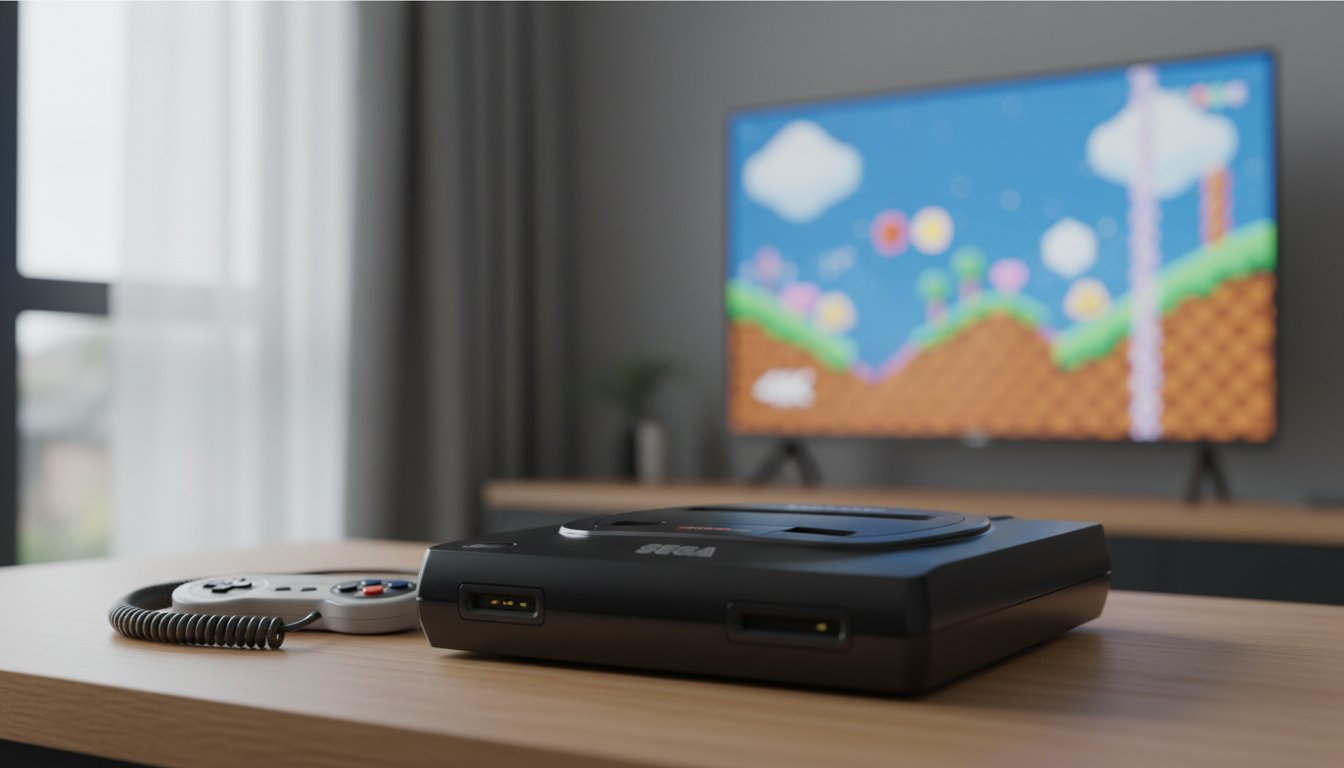
That nostalgic itch to hear the iconic ‘SEGA!’ chime is hard to ignore, isn’t it? For many of us, the memories of blistering through Green Hill Zone or battling through the Streets of Rage are pure magic. But diving back into that 16-bit world today can feel overwhelming. Which model should you hunt for? How on earth do you connect it to a modern 4K TV without it looking like a blurry mess? And with a library of hundreds of games, where do you even start?
Fear not, fellow retro enthusiast! Consider this your ultimate guide to the legendary Sega Mega Drive. We’re here to help you get your fix of 90s nostalgia, covering everything from the console’s epic history to the practical steps of buying and upgrading one in the UK today. We’ll break down the different models, reveal the best cables for a crystal-clear picture, and hand-pick the absolute must-play games to kickstart your collection.
By the time you’re done, you’ll have all the expert knowledge you need to confidently find a reliable console, hook it up like a pro, and recapture the joy of one of gaming’s greatest eras. Let’s power on.
In the late 1980s, the video game world was dominated by one name: Nintendo. But in 1988, Sega unleashed a true challenger in Japan, a sleek black console with immense potential. This was the Sega Mega Drive, a 16-bit powerhouse built with one clear goal – to do what others couldn’t and dethrone the king. Its arrival in Europe in 1990 marked the beginning of a new era, one defined by speed, attitude, and a legendary rivalry.
While technically impressive, the Mega Drive’s true genius lay in its marketing. Sega positioned it not as a toy, but as a cool, almost rebellious piece of tech. This edgy identity was perfectly crystallised with the birth of its new mascot, Sonic the Hedgehog. Fast, spiky, and full of attitude, Sonic was the antithesis of Nintendo’s cheerful plumber. He was the face of a new generation of gaming, one that was faster and more action-packed. In North America, where the console was famously known as the Sega Genesis, this aggressive marketing ignited a cultural phenomenon.
At the heart of the Mega Drive was the powerful Motorola 68000 CPU, clocked significantly faster than its main rival’s. This raw speed was the real secret behind Sega’s infamous marketing buzzword, ‘Blast Processing’. While the term was more hype than a specific technology, it highlighted the console’s ability to handle fast-scrolling action. This was complemented by the iconic Yamaha YM2612 sound chip, which gave games a distinct, crunchy FM synthesis sound, and a Zilog Z80 co-processor for sound control and Master System compatibility.
The rivalry between Sega and Nintendo was legendary. Sega’s aggressive advertising, with slogans like ‘Genesis does what Nintendon’t’, directly targeted its competitor. This war was fought in the arcades and on living room floors, with iconic franchise face-offs like Sonic the Hedgehog vs. Super Mario World and the gritty Streets of Rage vs. Final Fight. This fierce competition, fueled by crucial third-party support from companies like Electronic Arts, pushed both sides to innovate, leaving players with an unforgettable library of classic titles.
Ready to get your fix of 16-bit nostalgia? The Sega Mega Drive is an absolutely fantastic starting point for any retro collector. With a vast library of iconic games, a durable design, and an affordable entry price, it delivers pure gaming joy. Its place in gaming history is undeniable, as documented by institutions like the Centre for Computing History, making it a cornerstone for any serious collection. But before you buy, it’s crucial to know what you’re looking for.
The original Model 1 is the chunky, classic design many remember, complete with its iconic “High Definition Graphics” text and a headphone jack with a dedicated volume slider. Audio purists swear by the superior sound chip found in earlier Model 1 revisions. The later Model 2 is a smaller, more streamlined console designed to cut costs. It lacks the headphone port but features a more common 9-pin mini-DIN A/V port, making video cables slightly easier to find today than the Model 1’s 8-pin DIN.
This is a critical choice for modern players. UK and European (PAL) consoles run games at 50Hz, which is about 17% slower than the 60Hz NTSC (US/Japanese) versions. This often resulted in black borders at the top and bottom of the screen. For the authentic, full-speed experience the developers intended, an NTSC console is generally the best choice. While some cartridges are physically shaped differently or have lock-out chips, region-free mods are a popular and worthwhile upgrade for any serious sega mega drive enthusiast.
When buying a used console, don’t be afraid to ask the right questions. A good seller will be happy to provide details. Here’s what you need to confirm:
If original hardware feels like too much of a project, don’t worry! Modern alternatives like Sega’s own Mega Drive Mini or high-quality clones from companies like Analogue offer a perfect, plug-and-play HD experience for modern TVs.
The Sega Mega Drive was a beast built for speed and action, bringing the authentic arcade experience directly into our living rooms. Its library is a treasure trove of fast-paced platformers, gritty brawlers, and explosive shooters that defined a generation. Building your collection is a journey of rediscovery, so here are the essential titles-from iconic blockbusters to cherished hidden gems-that every collector should own.
This is the Mega Drive’s home turf. These games represent the console at its absolute best: fast, colourful, and relentlessly fun.
While known for action, the Mega Drive also hosted some of the most compelling role-playing and strategy games of the era.
Dig a little deeper and you’ll find incredible games that deserve a spot on your shelf.
This list is just the start of an incredible journey into the console’s library. Each of these games is a fantastic cornerstone for any collection. Ready to start your quest? Find these classic Mega Drive games in our store!
So, you’ve dusted off your cherished Sega Mega Drive, plugged it into your shiny new 4K TV, and… it looks like a blurry, washed-out mess. Don’t despair! This is a common problem. Modern TVs simply don’t know how to correctly handle the low-resolution analogue signals of classic consoles. But getting that crisp, vibrant picture you remember is entirely possible, and we’re here to show you how.
Getting the best signal starts with the right cable. The one you use makes a monumental difference to the final image quality. Here’s a quick rundown of your choices:
To take your visual experience to the next level, you need an upscaler. These brilliant devices take the Mega Drive’s native 240p signal and ‘line-double’ it to 480p or higher-a resolution your HDTV can display perfectly without adding blur or, crucially, input lag. The result is a razor-sharp image with perfect pixel definition, eliminating the annoying ‘shimmer’ you often see on sprites.
For a simple, plug-and-play solution, the RetroTINK family (like the 2X-Pro or 5X-Pro) is a fantastic choice for beginners. For enthusiasts who want to fine-tune every aspect of the image, the OSSC (Open Source Scan Converter) offers incredible control. While they can be an investment, often starting from around £100, the visual payoff is immense.
Ultimately, combining a high-quality RGB SCART cable with a dedicated upscaler is the best way to make your classic console shine on a modern screen. To get the best experience from your hardware, explore our range of premium cables and services over at myretrofix.co.uk.
Your cherished Sega Mega Drive has provided decades of joy, but like any classic hardware pushing 30 years old, it can start to show its age. Far from being the end of the road, this is an opportunity for collectors to restore and enhance their consoles, ensuring they perform better than ever for years to come.
From a flickering screen to games that simply refuse to load, several common issues can arise. Thankfully, most are well-understood and fixable in the right hands. Key problems include:
Want to unlock the true potential of your console? Modding can transform your gaming experience, breaking down the limitations of the original hardware. These delicate procedures require expert soldering skills but deliver incredible results.
While the world of mods is exciting, a single slip with a soldering iron can permanently damage your console’s motherboard. Don’t risk your treasured hardware on a DIY attempt. At RetroFix, we live and breathe this stuff, treating every retro console with the passion and precision it deserves.
We provide the peace of mind that comes from a professional service, guaranteeing quality workmanship that will keep your collection running perfectly. Ready to restore or upgrade your console? Get a quote for your Mega Drive repair or modification service. Let’s keep the 16-bit dream alive together.
More than three decades after its debut, the legacy of the Sega Mega Drive is stronger than ever. From its revolutionary history and iconic library of games to the modern ways we can connect, modify, and preserve these amazing machines, it’s clear this console is timeless. For both seasoned collectors and newcomers, the thrill of that 16-bit magic is just as potent today as it was in the ’90s.
Your adventure is just getting started. As passionate experts who love what we sell, we’re here to help you build your ultimate collection or get your original hardware in peak condition. We’re specialists in professional console repairs and mods, and we hunt down a wide range of rare and imported retro games so you don’t have to.
Ready to hear that iconic SEGA startup sound again? Get your fix! Shop our range of Sega Mega Drive consoles and games. The blast processing is waiting!
Absolutely! They are the exact same iconic 16-bit hardware. The console was named the Sega Genesis in North America due to a trademark issue, while here in the UK, Europe, and Japan, it was known as the Mega Drive. For collectors, the main difference is the region (PAL for the UK vs. NTSC for North America), which can affect game compatibility and refresh rates. So, when you’re collecting in the UK, you’re hunting for the Mega Drive!
The value varies massively depending on the model, condition, and what’s included. In the UK, a loose console can go for around £30-£50. A complete, boxed Model 1 in good condition could fetch anywhere from £80 to over £150, especially with popular games. It’s all about finding that perfect piece for your collection, and the thrill of the hunt is part of the fun!
Yes, and the library is incredible! The retro gaming scene is thriving, and you can find a massive selection of classic cartridges from specialist shops, online marketplaces, and gaming conventions. From common classics like Sonic the Hedgehog to rare Japanese imports, building your physical collection has never been more exciting. There are even brand new indie games being developed for the system today!
The Mega Drive Mini is a fantastic modern tribute from Sega. It’s a miniature, plug-and-play replica of the original console that connects to modern TVs via HDMI. It comes pre-loaded with a curated library of over 40 classic games, making it a super convenient way to get a nostalgia fix. However, it doesn’t play original cartridges, so it’s more for casual play than for the dedicated hardware collector.
They are two different, glorious generations of Sega hardware. The Master System was Sega’s 8-bit console, a direct competitor to the NES. The Mega Drive is its much more powerful 16-bit successor, designed to take on the SNES. A brilliant feature for collectors is that you can play Master System cartridges on a Mega Drive using a Power Base Converter add-on, giving you access to two amazing game libraries on one machine!
Not at all! The core Sega Mega Drive library, with hundreds of incredible titles, requires only the base console. The Mega-CD and 32X were optional, high-performance add-ons that expanded the console’s capabilities and had their own exclusive game libraries. While they are not essential, they represent an exciting path for serious collectors looking to experience everything the 16-bit era had to offer.