Get your fix of everything retro — specialists in imported & rare retroImported & Rare Retro

Shop By
Are Repro Games Worth It? The Ultimate Collector’s Guide for 2026
You’ve found it. That holy grail game you’ve hunted for years, listed online for a tempting £50 instead of its usual eye-watering price tag. The...

You’ve found it. That holy grail game you’ve hunted for years, listed online for a tempting £50 instead of its usual eye-watering price tag. The thrill is real, but so is the doubt that follows. What happens if you sink 40 hours into an epic RPG, only for a corrupt save file to wipe it all away? Could that budget cart damage the pins on your cherished, original console? It’s the dilemma every collector faces, forcing us to ask: are repro games worth it in 2026?
For the love of everything retro, we’re here to help you get your fix without the fear. In this ultimate guide, we’re diving deep to expose the hidden risks, the surprising performance truths, and the ethical debates surrounding reproduction games. We’ll arm you with the knowledge to spot a fake, understand the reliability of modern repros, and decide once and for all if they deserve a spot in your collection-or if there are better ways to play those rare classics.
Key Takeaways
- Learn how to spot a fake cartridge in seconds using simple checks for screws, labels, and circuit boards to protect your collection.
- Uncover the hidden technical risks, including how a cheap repro can erase your save data or even permanently damage your cherished console hardware.
- Discover the financial truth behind the ‘Nostalgia Tax’ and why, when asking are repro games worth it, their resale value instantly drops to £0.
- Explore superior alternatives for getting your retro fix, from using ‘placeholders’ correctly to investing in authentic play that honours the hobby.
What Are Reproduction Games and Why Are They Flooding the UK Market?
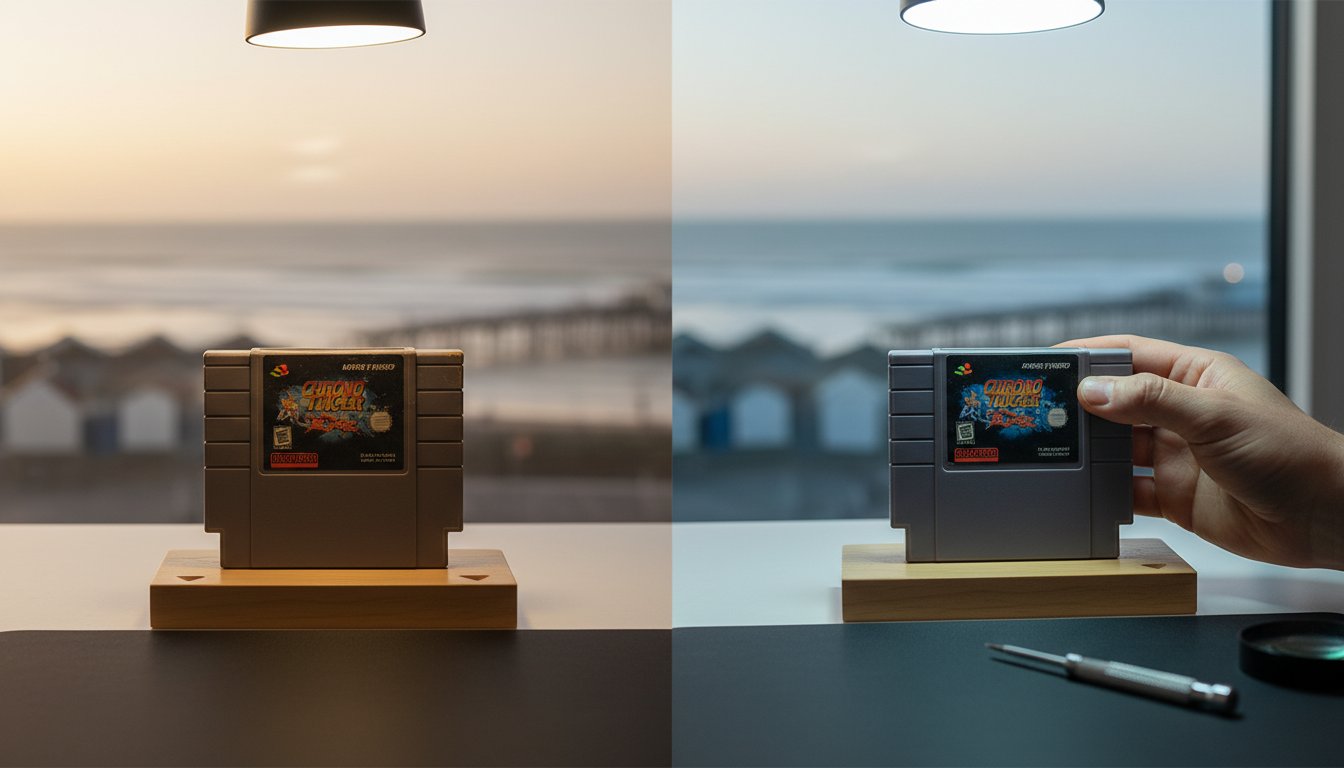
Ever spotted a mint-condition copy of Chrono Trigger for the SNES priced at just £25 and thought it was the deal of a lifetime? Chances are, you’ve encountered a reproduction (or “repro”) game. In simple terms, these are modern-made copies of classic video games, manufactured today using new components to look and play like the originals. They exist because of the “Nostalgia Tax”-the soaring prices for authentic, cherished titles that can now run into hundreds, or even thousands, of pounds.
This price boom has created a massive gap in the market, especially here in the UK. While some repros are born from passion, like high-quality fan translations of Japanese-only RPGs, the vast majority are deceptive bootlegs. These fakes are designed to mimic authentic cartridges and are sold on marketplaces like eBay and Etsy, often with vague descriptions. The sellers are banking on buyers who are either unaware or just want a cheap way to play. This practice is not just unethical; a closer look into understanding copyright infringement shows the serious legal lines being crossed.
The Anatomy of a Repro Cartridge
At their core, repros are fundamentally different from the genuine article. Authentic cartridges used Mask ROM technology, where the game data was permanently written at the factory. Repros use modern, rewritable flash memory. Physically, the differences can be obvious if you know what to look for. They often use cheap, lightweight plastic shells that fail the classic collector’s “weight test”-they just don’t have the same heft as an original. The most commonly targeted consoles are those with high-value libraries, such as the Game Boy, SNES, and Mega Drive.
Why 2026 is the Year of the “Super-Fake”
The days of spotting a fake by its blurry label are ending. As printing technology becomes more accessible, reproducers are creating “super-fakes” with near-perfect labels, boxes, and even manuals to mimic valuable Complete-in-Box (CIB) sets. This makes asking “are repro games worth it” a more complicated question than ever. UK collectors should be especially wary of “untested” or “attic find” game bundles, a common tactic used by sellers to offload convincing fakes alongside a few genuine, low-value titles, making the scam harder to spot at first glance.
Performance vs. Price: The Technical Risks of Repro Cartridges
That £15 price tag for a copy of Chrono Trigger looks incredibly tempting next to an authentic cart costing ten times as much. But before you add it to your basket, it’s crucial to understand the hidden technical “costs” that come with reproduction cartridges. These aren’t just ethical grey areas; they pose tangible risks to your cherished hardware and your gaming experience. The initial saving often masks potential heartbreak, from lost save files to a permanently damaged console.
So, when you factor in the long-term health of your gear, are repro games worth it? Let’s break down the technical gamble you’re taking.
- The “Save Battery” Gamble: Many repros use cheap, low-quality batteries and faulty save circuits. It’s a notorious issue where your 20+ hour RPG save file suddenly vanishes without a trace.
- Visual and Audio Glitches: The experience is rarely pixel-perfect. Expect graphical tearing, incorrect colours, garbled sprites, and missing audio channels that shatter the nostalgic immersion.
- Physical Fit Issues: Cheaply moulded plastic shells are often too thick or rough. Forcing one into your console can bend the delicate pins in the cartridge slot, leading to an expensive repair job.
The 3.3V vs 5V Technical Conflict
At the heart of the hardware risk is a fundamental electrical mismatch. Your classic consoles, like the SNES and Mega Drive, were designed to run games on 5-volt (5V) logic chips. Most modern repros are built using cheap, mass-produced 3.3V flash memory. Forcing a 3.3V cart to run on a 5V system puts immense stress on your console’s internal power regulator and the cartridge port pins over time. In this context, voltage sag is when the console’s power supply momentarily dips because the mismatched cartridge draws power incorrectly, often causing the game to crash or reset.
Software Incompatibility and Crashes
Beyond the hardware, the software itself is a minefield. Developers in the 90s were clever, and many iconic games contain hidden anti-piracy triggers. These measures were designed to protect their intellectual property, which is built on foundational legal principles of copyright. The most infamous example is Earthbound, which will load extra enemies and then maliciously delete your save file just before the final boss if it detects it’s a copy. Similarly, fake Pokémon games often fail to save properly or trade with official copies. High-bandwidth titles that pushed the original hardware, like Star Fox, often suffer from severe frame rate drops on inferior repro chips. The worst offenders are the “100-in-1” multi-carts, which are a chaotic lottery of buggy menus, incomplete ROMs, and non-functional saves, making the question of whether repro games are worth it a resounding “no” in their case.
The Collector’s Dilemma: Investment Value and Ethics
Beyond the simple act of playing, choosing between a reproduction and an authentic game touches the very soul of the retro hobby. It’s a question of value, legacy, and the health of the community we all love. For any serious enthusiast, this is where the cheap appeal of a repro starts to unravel, revealing significant long-term costs.
Repros as Financial Dead Ends
From a purely financial standpoint, the answer to “are repro games worth it” is a resounding no. Think of it this way: a genuine, loose cartridge of Pokémon Emerald on the Game Boy Advance can command prices upwards of £100 and continues to appreciate. A repro costs maybe £15, but its resale value is effectively £0 the moment you buy it. Reputable UK shops and online marketplaces will not touch them, and trying to sell one privately without clear disclosure is deeply unethical. A collection built on fakes is not an asset; it’s a liability with no real-world value, serving only as a temporary “placeholder” on your shelf.
The Ethics of the Retro Hobby
The impact of repros goes far beyond your wallet. They flood the market, making it harder for newcomers to find genuine copies and often leading to them being scammed. This deception isn’t just a local problem; it’s a global issue with severe consequences, highlighted by cases leading to a criminal conviction for selling counterfeit games. When you buy authentic, you’re doing more than just acquiring a game; you’re supporting the entire ecosystem. You’re helping independent shops that meticulously test and verify stock, and you’re funding the very “fix” culture we champion. Every pound spent on a genuine classic helps ensure the specialists who repair, recap, and mod our cherished consoles can keep doing what they do. After all, original hardware deserves original software.
How to Spot a Repro and Better Alternatives for Play
So, you’re on the hunt for a classic, but you want to make sure you’re getting the real deal. Spotting a reproduction can feel like a dark art, but with a few key checks, you can become a pro. Beyond just avoiding fakes, there are far superior ways to get your retro fix on original hardware without compromising on quality or safety.
The 5-Minute Authenticity Checklist
Before you part with your cash, run through these quick inspections. While some fakes are getting better, they almost always cut corners somewhere. Here’s what to look for:
- Label & Plastic Quality: An authentic label has a high-quality, glossy finish and precise printing. Look for the small, factory-imprinted number stamped into the back label on many Nintendo carts-it’s a detail fakers often miss. The plastic shell should also feel solid, not cheap or flimsy.
- The Screws: Nintendo used proprietary screws (3.8mm and 4.5mm “Gamebit” screws for older carts, and Tri-wing for GBA) to keep people out. If you see a standard Phillips head screw, it’s a massive red flag.
- The PCB is the Proof: The only definitive way to check is to open the cart. A genuine Printed Circuit Board (PCB) is a thing of beauty-cleanly laid out with Nintendo branding and high-quality chips. Repros often have messy soldering and a tell-tale black “glop-top” epoxy blob where the main chip should be. Refer to our visual Spotting Fakes guide for more detailed examples.
Why Flash Carts are the Real “Worth It” Option
When people ask us are repro games worth it for gameplay, our answer is almost always the same: invest in a flash cart instead. For a serious player, devices like an EverDrive or an EZ-Flash are a game-changer. Think of it this way: a single high-quality repro might cost £20. For the price of five or six of those, you could buy a flash cart that holds your entire game library on one SD card.
These carts are engineered to work perfectly and safely with your original console, eliminating the voltage risks associated with cheap fakes. You get reliable saving, instant loading, and even bonus features like save states. It’s a one-time investment that delivers an authentic experience on your cherished hardware without the clutter or the gamble. When you weigh the cost against the reliability and sheer convenience, a flash cart is the truly “worth it” choice for playing your favourite classics.
For the ultimate purists seeking pixel-perfect visuals, modern solutions like FPGA hardware (think Analogue Pocket) and high-quality emulation offer an incredible experience. But for the joy of using your original console, nothing beats the power and reliability of a quality flash cart.
The RetroFix Verdict: Get Your Fix the Right Way
After weighing the pros and cons, the question remains: are repro games worth it? Here at RetroFix, our answer is a passionate and resounding no. We believe the soul of retro gaming lies in authenticity. There’s an undeniable magic in holding a piece of gaming history-the weight of the cartridge, the original label art, the knowledge that this very object brought joy to someone decades ago. It’s a tangible connection to the past that a modern counterfeit simply cannot replicate.
While repros might seem like a cheap fix, they often come with hidden costs like save-file corruption and poor build quality. When you truly consider if are repro games worth it for the long haul, the answer is clear. Many cherished original cartridges, like Pokémon Gold or Silver, are discarded because of a dead battery. But that’s a simple fix for us! Our repair services can breathe new life into your original carts, replacing old batteries and ensuring your saved progress is secure for years to come. Investing a little in a repair is always better than wasting money on an unreliable fake.
Optimising Your Original Hardware
Authentic play doesn’t mean you’re stuck with 90s technology. The ultimate retro experience combines genuine software with modern hardware enhancements. An IPS screen mod for your Game Boy makes the original cartridge’s pixel art pop with vibrant colour and clarity. A full re-cap for your SNES or Mega Drive ensures its longevity, protecting it for another generation. This is how you honour the classics-by giving them the best possible stage to shine on.
Join the Community of Enthusiasts
We’re more than just a shop; we’re a hub for fellow enthusiasts. If you’re ever in Worthing, pop in and say hello! We love showing fellow gamers our curated collection, especially our rare imports. We specialise in NTSC-J (Japanese) titles, which are often a fantastic, cost-effective way to own an authentic copy of a game that might cost hundreds of pounds in its PAL version. It’s the perfect way to build an amazing, genuine collection without breaking the bank. Ready to start? Get your fix of everything retro at MyRetroFix!
The RetroFix Verdict: Why Authenticity Always Wins
So, when you ask the question, are repro games worth it? From a true collector’s standpoint, the answer is a clear no. While the low price of a reproduction cartridge might seem tempting, you’re sacrificing reliability, performance, and any hope of future value. These fakes not only risk damaging your classic hardware but also undermine the very passion for preservation that drives our community. The thrill of retro gaming comes from experiencing a genuine piece of history, not a cheap imitation.
As passionate hobbyists based in Worthing, UK, we believe in the magic of the genuine article. As specialists in imported and rare retro titles, we do the hard work of sourcing and verifying authentic classics, so you can build a collection you’re proud of. We also provide professional console repair and modification services to ensure you get the best possible experience from your cherished hardware. Ready to own the real deal? Shop Authentic Rare & Imported Retro Games and get your fix the right way.
Happy collecting!
Frequently Asked Questions
Do repro games damage your console?
A well-made reproduction game is highly unlikely to damage your console. Reputable repros use modern, correctly-specced components that are safe for your cherished hardware. The risk comes from low-quality, mass-produced cartridges, which might use incorrect voltages (like 5v instead of 3.3v for a GBA). While rare, this could theoretically strain your system over time. Stick to trusted sellers to ensure your console’s long-term health and keep the retro magic alive.
Do reproduction games save progress reliably?
This is a classic concern! The reliability of a repro’s save function depends entirely on its internal components. Older-style repros might use a battery (SRAM), which can fail just like an original cart. However, most modern, high-quality reproductions use FRAM or EEPROM, which are non-volatile memory types. This means they don’t need a battery to hold your save data, making them incredibly reliable for those long RPG sessions. Always ask the seller what type of save memory is used.
Is it illegal to buy reproduction games in the UK?
In the UK, the law primarily targets the sellers, not the buyers. While selling counterfeit goods infringes on copyright and trademark laws, buying a reproduction game for your personal collection is a legal grey area and is highly unlikely to face any legal action. The key issue is misrepresentation; it becomes a serious problem when a repro is sold as an authentic, original copy. As a buyer for personal use, you are not the focus of enforcement.
What is the difference between a reproduction and a bootleg?
While often used interchangeably, in the retro community there’s a difference in intent and quality. A “reproduction” is typically a high-quality copy created for enthusiasts to experience a rare or expensive game, often sold transparently as a repro. A “bootleg” usually refers to a cheap, low-quality fake, often with poor labels, shoddy materials, and glitches. Bootlegs are frequently passed off as genuine, whereas good reproductions are meant to be affordable, playable alternatives.
Can you play repro games on a Retron 5 or Analogue Pocket?
It’s a bit of a gamble, as it depends on the specific repro and the console. Systems like the Analogue Pocket and Retron 5 are designed to dump the ROM from an authentic cartridge. Some high-quality repros behave just like the real deal and work flawlessly. However, many others, especially cheaper ones, use non-standard hardware that these systems can’t read, causing them to fail. There’s no definitive list of what works, so compatibility is never guaranteed.
Why are some repro games more expensive than others?
The price difference boils down to the quality of the components and the love put into it. A cheap £10-£15 repro often uses generic circuit boards and low-grade plastics. A more expensive one, say £30-£40, likely features a custom-designed board, superior save memory like FRAM, a high-resolution label, and a quality shell. When asking are repro games worth it, consider that paying more often gets you a far more reliable and authentic-feeling product that will last for years.
How can I tell if a Game Boy game is a reproduction?
Spotting a Game Boy repro gets easier with practice! First, check the label: look for blurry images, incorrect fonts, or a glossy finish where it should be matte. The plastic cartridge shell might feel cheap or be a slightly ‘off’ shade of grey. On top, fakes often have a different font for the “GAME BOY” text. The ultimate test is the screw on the back – if it’s a standard Phillips screw instead of the special 3.8mm gamebit, it’s a fake.
Are reproduction boxes and manuals worth anything?
For a collector focused purely on investment, original boxes and manuals are king. However, for the passionate player who wants that amazing “complete in box” look on their shelf, reproduction packaging is fantastic. It allows you to display your cherished games beautifully without spending hundreds of pounds on cardboard. So, while they don’t hold resale value like originals, the answer to “are repro games worth it” for display purposes is a resounding yes – they offer immense aesthetic value.